Let It Ride strategy advisor
Tap your three dealt cards and the advisor gives the correct first-bet play; tap a fourth card for the second-bet decision, and a fifth to see your final hand. It applies the optimal Let It Ride strategy exactly, so you can practise letting bets ride and pulling them until the rules are second nature:
How Let It Ride works
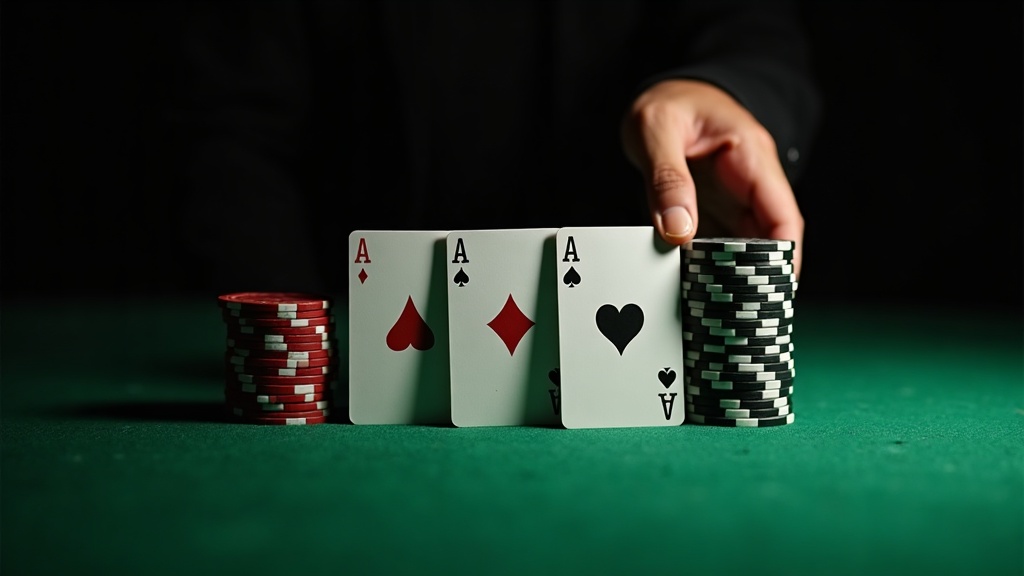
Before you can talk strategy you need the flow of the game. In Let It Ride you make three equal bets up front. You then receive three cards, and two community cards are added to make your final five-card poker hand. The twist that gives Let It Ride its name is that two of your three bets are yours to take back: you only leave them out — you "let it ride" — when the cards justify it. The third bet always rides. Your final hand pays on a pair of tens or better, and every bet you let ride is paid at the same rate.
So each hand you make two decisions in sequence. After looking at your three cards, you decide whether to pull the first bet or let it ride. Then the first community card is turned, and with four cards known you decide whether to pull the second bet or let it ride. Because pulling a bet simply returns your money at no cost, correct Let It Ride strategy is conservative: you only let a bet ride when the math is genuinely in your favour, and you pull it back the rest of the time.
The two rules of optimal Let It Ride strategy
The whole of optimal Let It Ride strategy is two short lists — one for each decision. Learn them and you never have to guess when to play Let It Ride correctly.
(3 cards)
(4 cards)
First bet: your three-card decision
With three cards in front of you, let the first bet ride only when you hold one of these:
- A paying hand — a pair of tens or better, or three of a kind. These already win, so you always let them ride.
- Three to a royal flush — any three of ten, jack, queen, king or ace in the same suit.
- Three to a straight flush — three suited cards that can grow into a straight flush: consecutive cards (except the two lowest runs), a one-gap draw with at least one high card, or a two-gap draw with two high cards.
Every other three-card holding — a low pair, two high cards, a bare flush draw with no straight potential — is a pull. It feels strange to pull with two paint cards in your hand, but the numbers are clear: letting bets ride on hopeful hands is exactly how players give the house extra edge.
Second bet: your four-card decision
Once the fourth card appears you know four of your five cards, and the second-bet rule is just as tight. Let the second bet ride only with:
- A paying hand — a made pair of tens or better, two pair, or trips.
- Four to a flush — any four cards of the same suit. This also covers four to a straight flush and four to a royal.
- Four to an outside straight — four cards in a row that can complete on either end, such as 6-7-8-9. Note that four to an inside straight, and runs like J-Q-K-A that only fill from one side, do not qualify.
Anything else is a pull. In particular, four high cards, an inside straight draw, and three-to-a-flush are all pulls on the second bet — none of them makes the paying hand often enough to leave money out.
Let It Ride pay table and house edge
Each bet you let ride is paid at the same schedule, on a pair of tens or better:
| Final hand | Pays (to 1) |
|---|---|
| Royal flush | 1000 |
| Straight flush | 200 |
| Four of a kind | 50 |
| Full house | 11 |
| Flush | 8 |
| Straight | 5 |
| Three of a kind | 3 |
| Two pair | 2 |
| Pair of tens or better | 1 |
Playing the optimal strategy above, the house edge in Let It Ride is about 3.51% of a single base bet. Because you pull two of your three bets so often, the edge measured against the money you actually leave at risk — the element of risk — is lower, around 2.85%. That gap is the whole point of the game: the strategy is really a discipline for keeping your average bet small while still catching every hand that pays.
Practise, then play
Run a few dozen hands through the advisor above until the two rule-lists feel automatic. Watch the three common leaks: letting the first bet ride with any pair (only tens or better is a paying hand), chasing inside straights on the second bet, and treating three unsuited high cards as a reason to ride. For other low-edge table games with clean, learnable strategy, see our Three Card Poker strategy, Ultimate Texas Hold'em strategy and Caribbean Stud strategy.
Frequently asked questions
What is the best Let It Ride strategy?
Let the first bet ride only with a paying hand, three to a royal flush, or a strong three-card straight flush; let the second bet ride only with a paying hand, four to a flush, or a four-card outside straight. Pull every other time.
What is the house edge in Let It Ride?
With optimal Let It Ride strategy the house edge is about 3.51% of a single base bet, or roughly 2.85% measured against the average amount actually at risk.
When should you let it ride?
You should let it ride when your cards already make a paying hand or have a strong draw to one. On three cards that means a pair of tens or better, trips, or a good straight-flush draw; on four cards it means a paying hand, four to a flush, or an open-ended straight.
The advisor applies the standard optimal Let It Ride strategy; casino pay tables vary slightly by property, which can move the house edge a fraction. Educational content about probability, not gambling advice.